

Positive Aspects of Valid Dumps HPE7-A08 Exam Dumps! [May-2026]
First Attempt Guaranteed Success in HPE7-A08 Exam 2026
NEW QUESTION # 24
You have added a switch with existing configuration to an existing group in HPE Aruba Networking Central, but the configuration is not synchronizing. What could cause this?
- A. The switch is still pending authorization on the organization settings page.
- B. Configuration auto-commit has been disabled for the group in HPE Aruba Networking Central.
- C. Only switches with factory default config can be added to a group with existing config.
- D. The switch is configured in a VSX pair, which HPE Aruba Networking Central does not support.
Answer: C
NEW QUESTION # 25
A network administrator is implementing a configuration plan in NetEdit. The administrator used NetEdit to push the configuration plan to the switch. Which option in the NetEdit planning section should the administrator select to save the configuration running on the switch to the startup- config?
- A. COMMIT
- B. VALIDATE
- C. EDIT
- D. DEPLOY
Answer: A
Explanation:
Deploy puts the config to running-config, Commit saves it to startup-config.
NEW QUESTION # 26
Your customer's CISO would like to deploy colorless ports across the network. Which will you need to configure to meet this requirement?
- A. VSF
- B. VRRP
- C. VNBT
- D. VRF
Answer: C
Explanation:
Colorless ports allow network devices to move or replace endpoints without changing port-level configurations, typically by automatically assigning network policies dynamically to any port.
HPE Aruba's solution for colorless ports is the VNBT (Virtual Network Boundary Tagging) feature. VNBT allows dynamic segmentation of traffic, so ports can automatically take on the policies assigned to devices regardless of physical port location.
VRRP is a first-hop redundancy protocol and unrelated to port colorlessness.
VSF (Virtual Switching Framework) is for switch stacking.
VRF (Virtual Routing and Forwarding) is for traffic segmentation.
Thus, VNBT is the correct feature to meet colorless port requirements.
References:
Aruba Dynamic Segmentation and VNBT Whitepapers
ArubaOS-CX User Guide for Dynamic Segmentation
Aruba Tech Docs on Colorless Ports and VNBT
NEW QUESTION # 27
A network administrator wants to replace older access layer switches with AOS-CX 6300 switches.
Which virtual switching technology can the administrator implement with this solution?
- A. Only VSF
- B. Only VSX
- C. Both VSF and VSX
- D. Only Backplane stacking
Answer: A
NEW QUESTION # 28
Examine the AOS-CX configuration: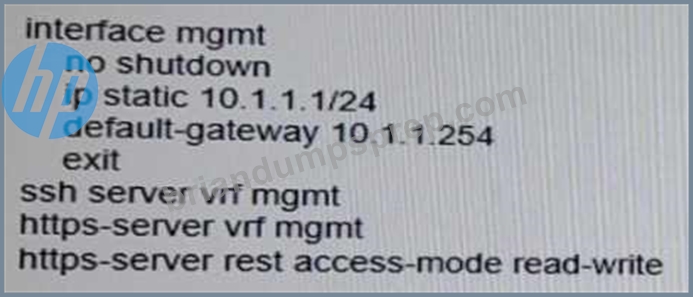
The switches have a default factory password setting NetEdit fails to access the configuration of the AOS-CX switches. What should the administrator do to solve this problem?
- A. Use the default VRF instead of the mgmt VRF
- B. Enable IP routing globally
- C. Disable telnet globally.
- D. Set a password for the default admin user account.
Answer: B
NEW QUESTION # 29
Which CLI command configures an interface for strict priority queuing (SPQ)?
- A. apply priority-queue strict
- B. priority-queue strict
- C. traffic-priority high
- D. qos queue strict-priority
Answer: D
Explanation:
The qos queue strict-priority command ensures high-priority traffic is always processed before lower-priority traffic, minimizing latency for critical applications.
NEW QUESTION # 30
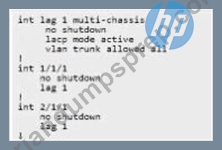
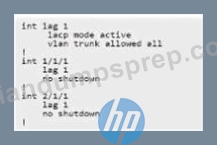
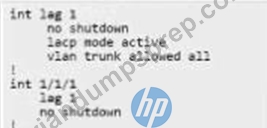
For the aggregation layer, you must configure two new HPE Aruba Networking CX 6200M (VSF) switches. LACP link aggregations to downstream access switches using redundant ports from both switches are required.
Which configuration example would create the required lag setup on both switches utilizing HPE Aruba Networking clustering and stacking technologies?
- A.
- B.
- C.
Answer: B
NEW QUESTION # 31
Which CLI command displays the status of all LLDP neighbors detected by an Aruba CX switch?
- A. show link-layer neighbors
- B. display lldp status
- C. show lldp neighbors
- D. show lldp topology
Answer: C
Explanation:
The show lldp neighbors command provides information on directly connected devices, helping troubleshoot network topology and verify proper device connectivity.
NEW QUESTION # 32
An administrator of a large campus network needs a solution that will provide root cause analytics to quickly identify problems so that they can quickly be fixed.
Which AOS-CX switch feature should the administrator utilize to help with root cause analytics?
- A. VSX
- B. NAE
- C. VoQ
- D. NetEdit
Answer: B
NEW QUESTION # 33
Which CLI command verifies the number of MAC addresses learned on a specific port?
- A. show interface mac
- B. show mac-learned 1/1/1
- C. show port-security interface 1/1/1
- D. show mac-table interface 1/1/1
Answer: C
Explanation:
The show port-security interface 1/1/1 command displays MAC addresses associated with a port, helping administrators enforce and troubleshoot security policies.
NEW QUESTION # 34
An administrator wants to leverage the Network Analysis Engine (NAE) feature on AOS-CX switches to perform root cause analysis and to assist in quickly identifying problems. Which two AOS-CX databases does the administrator have access to when implementing scripts? (Select two.)
- A. Time-series
- B. API
- C. Audit
- D. VSX
- E. Configuration
Answer: A,D
NEW QUESTION # 35
A customer wants to prevent 'man-in-the-middle' attacks based on Layer 2 addressing. What will help address that concern?
- A. Enable ARP inspection in the VLAN context
- B. Enable ARP inspection in the VLAN interface context
- C. Enable ARP inspection in interface-level context
- D. Enable ARP inspection in the global context
Answer: A
Explanation:
Comprehensive Detailed Explanation:
To prevent man-in-the-middle attacks based on Layer 2 (Ethernet) addressing, enabling ARP inspection in the VLAN context is recommended. ARP inspection validates ARP packets and ensures only legitimate ARP responses are forwarded.
Enabling ARP inspection at VLAN level allows granular control.
Interface-level or global context is less typical or supported for ARP inspection on Aruba CX switches.
References:
ArubaOS-CX Security Features Guide
HPE Aruba ARP Inspection Best Practices
Network Security Documentation for Aruba CX Switches
NEW QUESTION # 36
OSPF peering is configured between HPE Aruba Networking CX 6300 switches utilizing BFD.
You've made this configuration on switch B, while switch A is in the default configuration:
Which BFD Tx/Rx interval values will switch A use for the show bfd session?
- A. Switch A show BFD sessions using 300ms
- B. Switch A show BFD sessions using 2000ms
- C. Switch A show BFD sessions using 6000ms
- D. Switch A show BFD sessions using 500ms
Answer: B
NEW QUESTION # 37
Which CLI command displays QoS applied policies per interface?
- A. show applied qos
- B. display qos rules
- C. show qos policy interface
- D. show qos interface
Answer: D
Explanation:
The show qos interface command lists active QoS policies on switch ports, showing how traffic is classified and prioritized per interface.
NEW QUESTION # 38
Which CLI command displays the number of packets dropped due to queue congestion?
- A. display queue congestion
- B. show traffic loss
- C. show qos queue statistics
- D. show queue counters
Answer: C
Explanation:
The show qos queue statistics command provides details on queue behavior, helping identify traffic drops caused by buffer overflows and congestion.
NEW QUESTION # 39
Examine the network exhibit: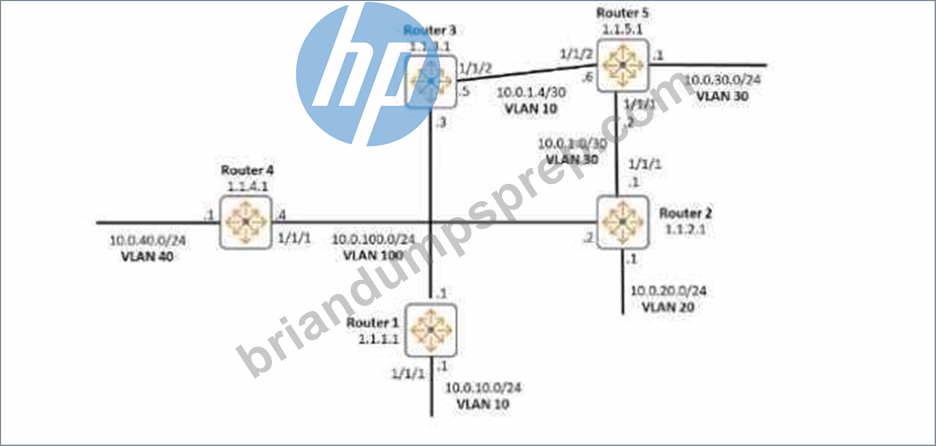
Examine Rome r4"s partial OSPF configuration:
router OSPF 1 Area 0
exit interface vlan 100
ip ospf area 0
exit interface vlan 40
ip ospf area 0
exit interface 1/1/1
vlan access 100
mtu9000
Ip ospt hello-Interval 1
Ip ospt dead-Interval 4
ip ospf authentication simple-text
ip ospf authentication-key key123
When executing the "show ip ospf neighbors" command, Router 4 is in a FULL state with Router
3 and Router 2, but a 2-WAY state with Route3.
What is causing the 2-WAY state with Router 1?
- A. The MTU size on interface 1/1/1 is mismatched with Router Vs VLAN 100 interface.
- B. Router 1 and Route1 3 have a mismatched authentication Key.
- C. The timers on Interface 1/1/1 Is mismatched with Router i's VLAN TOO interlace.
Answer: B
NEW QUESTION # 40
Which two CLI commands are used to reset a trunk port to its default settings? (Select two)
- A. reset trunk settings
- B. clear trunk configuration
- C. default interface
- D. no switchport mode trunk
Answer: C,D
Explanation:
The no switchport mode trunk and default interface commands remove trunk settings, restoring the port to its default configuration to fix misconfigurations.
NEW QUESTION # 41
What is true regarding VSX and keepalives on AOS-CX switches?
- A. A VSX LAG for the keepalives is a best practice.
- B. The OOBM port must be used.
- C. A 1GbE or faster port is used.
- D. A separate VLAN on the ISL link is used.
Answer: C
NEW QUESTION # 42
Which benefit is provided by MD5 authentication for BGP?
- A. It verifies that received BGP routes have valid next hop IP addresses.
- B. It enables users to authenticate to a server across BGP AS boundaries.
- C. It protects BGP routing information from eavesdroppers.
- D. It validates that BGP messages arrive from an authorized device.
Answer: D
NEW QUESTION # 43
Which CLI command displays the last recorded system log messages on an Aruba CX switch?
- A. show logging
- B. display log history
- C. show syslog
- D. show system logs
Answer: A
Explanation:
The show logging command provides system event logs, helping identify hardware failures, software crashes, and authentication errors.
NEW QUESTION # 44
Your customer has an existing gateway cluster that they are using to tunnel traffic from APs and would like to configure the same for their CX switches. Which tunneling option should you recommend?
- A. IPSec
- B. GRE
- C. VNBT
- D. UBT
Answer: D
NEW QUESTION # 45
......
HP HPE7-A08 Exam Syllabus Topics:
| Topic | Details |
|---|---|
| Topic 1 |
|
| Topic 2 |
|
| Topic 3 |
|
| Topic 4 |
|
Practice LATEST HPE7-A08 Exam Updated 250 Questions: https://passleader.briandumpsprep.com/HPE7-A08-prep-exam-braindumps.html
