

CTAL-TM-001 Certification Overview - [Jun 10, 2026] Latest CTAL-TM-001 PDF Dumps
The Best ISTQB CTAL-TM-001 Study Guides and Dumps of 2026
CTAL-TM Certification Path
6 months of experience in Software development/software testing. Successful completion of the ISTQB Certified Tester Foundation level and a minimum of three years testing experience is recommended. The Intermediate Certificate may also be helpful but is not required.
NEW QUESTION # 41
Which of the following aspects should test progress metrics be mapped to?
- A. Exit criteria
- B. Defect resolution rate
- C. Post-implementation defect discovery rate
- D. Lines of code
Answer: A
Explanation:
Test progress metrics should be mapped to exit criteria to ensure that the testing process aligns with the predefined standards for completion.Exit criteria typically include conditions such as coverage of test cases, pass rates, and the resolutionof major defects, which are essential for determining the end of the test phase.
References:The ISTQB Advanced Level Test Manager syllabus includes the evaluation of exit criteria as part of the test monitoring and control process1. It is crucial for test managers to define and evaluate these criteria to ensure that the testing objectives have been met and that the product is ready for releas
NEW QUESTION # 42
As a result of the RAD based development approach, the test manager has decided to change the risk mitigation approach. Which test technique might be most appropriate to use? 2 credits
- A. Boundary Value Analysis
- B. Error Guessing
- C. Decision Table Testing
- D. Exploratory Testing
Answer: D
Explanation:
Explanation/Reference:
Explanation:
NEW QUESTION # 43
You are a Test Manager at a company that develops mobile phone applications. Based on historical data in your company, you have calculated the following average metrics for system testing:
* for each 100 LOC (Lines Of Code). 4 test cases are executed
* each test case takes on average 15 minutes to execute and check
* for each 1000 LOC, 5 defects are found
You have used this information to create an estimate for the system testing of a new mobile phone application being developed to submit gas and electricity readings.
The application delivered for system testing has 50.000 lines of code. At the end of system testing, 250 defects are discovered.
Assume that:
* the system test of the new mobile phone application will require the same amount of effort as previous applications
* defect density = number of defects/1000 LOC
* no new tools or processes have been introduced to the test team
Based only on the given information, which one of the following statements is true about this new mobile phone application?
SELECT ONE OPTION
- A. The actual number of defects found is the same as the estimated number of defects.
- B. The source code contains a lower defect density than the source code of past applications
- C. 3000 test cases will be executed during system testing and 250 defects will be found.
- D. The time taken to run all the estimated tests would be 750 hours.
Answer: A
NEW QUESTION # 44
Which TWO of the following metrics will be MOST useful in helping the stakeholders to decide whether to allow the system into acceptance testing?
* Breakdown of all risks by status (closed / not fully tested / one or more tests failed)
* Breakdown by test priority of test execution status (passed / failed / not run)
* Breakdown of outstanding risks by risk level and status (not fully tested / one or more tests failed / both)
* Breakdown of unresolved defects by severity and status
* Breakdown of unresolved defects by Risk Id/s that is/are affected by them
- A. 1 &2
- B. 2&5
- C. 3&4
- D. 1 &4
Answer: C
Explanation:
Metrics are essential for test control and release decisions. The syllabus recommends providing stakeholders with data that describes:
* Residual risks(status of untested/high-risk items)
* Defect severity and status(unresolved issues critical to quality)
"Typical test summary reports may include:... metrics of defects, test cases, test coverage, activity progress and resource consumption..."
- ISTQB-CTFL_Syllabus_2018_V3.1, section 5.3.2
NEW QUESTION # 45
What is the purpose of the defect management committee?
- A. To validate defect reports and determine fix plans
- B. To control the flow of defect reports into the system
- C. To implement strict guidelines for defect report creation
- D. To ensure the developers fix all defects
Answer: A
Explanation:
* Purpose of the Defect Management Committee (DMC):
* The DMC evaluates reported defects to confirm their validity, prioritize them, and create plans for resolution.
* It ensures effective coordination between testers, developers, and stakeholders.
* Evaluation of Options:
* A(Controlling defect report flow) is a subset of validation but not the main purpose.
* Bis correct because it fully captures the committee's role.
* C(Implementing strict guidelines) is procedural, not the DMC's core function.
* D(Ensuring developers fix all defects) misrepresents the committee's authority.
References and Syllabus Alignment:
* This aligns with defect lifecycle management as described in "Defect Management" (TM-2.3.1).
NEW QUESTION # 46
You have been promoted to Test Manager within your company. Your new manager states that your test team utilized a risk-based test approach for the last release but in production, a number of serious failures in lightly tested areas have occurred.
What would be your first action prior to the start of the next test phase for the next release? [3]
- A. Review the test cases executed from the previous release.
- B. Request functional requirements be prioritized in order of importance to the stakeholder.
- C. Ensure you have the correct stakeholders' participation during the risk assessment process
- D. Review the production defects and determine if they are valid.
Answer: C
Explanation:
The best action that the Test Manager can take prior to the start of the next test phase for the next release is to ensure that the correct stakeholders' participation during the risk assessment process. This is because the risk assessment process is crucial for identifying and prioritizing the risks that may affect the quality of the system, andallocating testing resources accordingly. The correct stakeholders are those who have the authority, knowledge, and interest in the system and its risks, and who can provide valuable input and feedback to the test team. By involving the correct stakeholders, the Test Manager can ensure that the risk-based test approach is aligned with the project objectives and the stakeholder expectations, and that the most critical areas are tested adequately. References: Certified Tester Advanced Level Test Manager (CTAL-TM) - ISTQB not-for-profit association, ISTQB Test Manager Certification - ISTQB Exams Worldwide - ISTQB Official Registration, Managing the Test Team - ISTQB not-for-profit association
NEW QUESTION # 47
Which of the following Is a way in which risk analysis drives test analysis?
- A. It determines which tests should be executed first
- B. It influences the type of reporting that will be used during execution
- C. it drives root cause analysis for any defects found
- D. It guides the selection of test conditions that must be covered by testing
Answer: D
Explanation:
* Role of Risk Analysis in Test Analysis:
* Risk analysis identifies areas with the highest likelihood and impact of failure, enabling the test team to focus on critical functionalities.
* It is used to determine test conditions that must be addressed to mitigate risks effectively.
* Evaluation of Options:
* Ais incorrect as determining test execution order happens during test execution, not analysis.
* Bis correct because selecting test conditions is part of test analysis influenced by risk levels.
* Crelates to reporting and is unrelated to test analysis.
* Dpertains to defect management, not test analysis.
References and Syllabus Alignment:
* This aligns with risk-based testing as described in "Risk Analysis and Risk-Based Testing" (TM-1.3.1).
NEW QUESTION # 48
Which THREE activities would be valid steps during the development of the test strategy?2 credits (2 out of 3 correct 1 credit)
- A. Define a master test plan template
- B. Define test career paths
- C. Issue the test strategy document for review
- D. Assess the testing that needs to be done to minimize the risks
- E. Identify test staff members that will be involved in the system test
- F. Perform a project risk analysis
- G. Understand the software development life cycle used by the software house
Answer: C,D,G
Explanation:
Explanation/Reference:
Explanation:
NEW QUESTION # 49
Your testing team has just received the test conditions for a new project. You are conducting Test Design activities for this project. Your team feels that it would be beneficial to create high-level test cases.
What should they do concurrently with creating these test cases? [2]
- A. Create the test plan.
- B. Create the test automation scripts.
- C. Create the test summary report for the test cases you are creating.
- D. Create the traceability between the test cases and the requirements.
Answer: D
Explanation:
The correct answer is D. Create the traceability between the test cases and the requirements. This is because traceability is the ability to follow the life of a requirement, in both a forward and backward direction, through its documentation, development, and testing. Traceability can help to ensure that the test cases are derived from the requirements, and that they cover all the relevant aspects of the system. By creating the traceability between the test cases and the requirements concurrently with creating the test cases, the test team can improve the quality and completeness of the test design, and facilitate the test analysis and reporting. Traceability Matrix - ISTQB not-for-profit association References: Certified Tester Advanced Level Test Manager (CTAL-TM) - ISTQB not-for-profit association, ISTQB Test Manager Certification - ISTQB Exams Worldwide - ISTQB Official Registration, Traceability Matrix - ISTQB not-for-profit association
NEW QUESTION # 50
You plan to use a heavyweight approach to risk-based testing on a safety-critical system and have the following information available for each documented product risk:
* The estimated cost of testing the risk
* How likely a failure would arise for the risk item
* How much the failure would cost, in terms of lossWhich technique would be MOST suitable?
- A. Failure mode and effect analysis
- B. Systematic software testing
- C. Fault tree analysis
- D. Cost of exposure
Answer: D
Explanation:
TheCost of Exposuretechnique is most suitable when you have data on thecost of testing, thelikelihood of failure, and thecost of failure. Cost of Exposure = Likelihood × Impact, which is directly applicable here:
"Risk involves the possibility of an event in the future which has negative consequences. The level of risk is determined by the likelihood of the event and the impact (the harm) from that event".
This technique helps prioritize which risks justify more testing based on potential financial impact.
NEW QUESTION # 51
You are Test Manager on a major project that is of strategic importance to your company. Your team has access to a suite of testing tools that provide support across the development life cycle and this suite of tools has been in place for the last two projects. You are concerned that the suite does not have an integrated defect management tool and have negotiated a small budget to find and implement such a tool. Your first choice is an open source tool that has been available for just over a year and appears to be popular with its users, who have found it easy to learn. The main disadvantage of the tool would be that current manual defect management processes would need to be modified to embrace use of the tool.
Which of the following would be the MAIN risk to consider in deciding whether or not to acquire the defect management tool? SELECT ONE OPTION
- A. The risk of additional time and effort required to prepare and roll out a revised defect management process.
- B. The risk of not being able to integrate the tool within the existing tool suite to ensure effective interoperability across the whole suite.
- C. The risk of not achieving a positive Return on Investment for the tool in the short term.
- D. The risk of not being able to achieve effective training for users of the tool to ensure they can use it effectively.
Answer: C
NEW QUESTION # 52
SCENARIO 1
DreamPartner dating agency are redesigning their dating application following a major security breach in which sensitive customer data was made publically available. The redesign includes stronger security encryption and performance tuning.
The product risk register for the redesign project, which was produced after all requirements had been agreed, includes the following: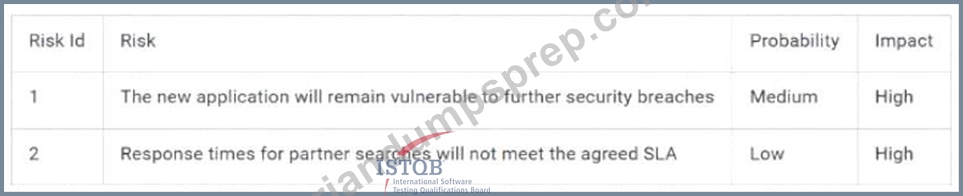
The organisational Test Strategy contains the following objectives:
1. A Risk-based lest approach must be adopted for all projects
2. Functional regression testing should start as soon as functional testing is complete
3. Automated tests may be run before or in parallel with manual tests
The project Test Plan has allocated 6 weeks to complete all test execution, with functional testing taking 3 weeks to execute, performance and security testing 2 weeks each and regression testing 1 week.
Which of the following options places the test suites (TS1 to TS5) in the correct order for test execution?
SELECT ONE OPTION
- A. TS1, TS2, TS5, TS3, TS4.
- B. TS5, TR1, TS3 TSA, TS2
- C. TS3, TS4, TS1, TS2, TS5.
- D. TS3, TS1, TS2, TS5, TS4.
Answer: D
NEW QUESTION # 53
Which of the following product risks would be most effectively addressed just by static testing? 3 credits
- A. The application takes too long to process a request for additional cover.
- B. The test cases do not cover the key requirements.
- C. In the delivered application, one of the countries, as specified in the requirements, has not been correctly implemented.
- D. The successful bidder may not deliver all the required functionality on time.
Answer: B
NEW QUESTION # 54
You are the Test Manager on a project to replace an old sales and merchandising system with one that will be based on modern platforms.
The main requirements for the system are:
* Loading sales data, sent electronically from the stores each evening, into a central database.
* Producing sales reports for the merchandisers.
* Producing forecast reports, used to predict demand.Loading sales data and producing reports with the current system has frequently taken longer than the overnight processing window allows. The Data Centre Manager requires that all batch processing takes at least 10% less time than currently.The Sales and Merchandising Manager is more concerned about usability because the parameter entry will be complex.Which option contains two key considerations that would need to be added to your test approach?
- A. Usability testing in pre-prod by the team; performance efficiency testing in pre-prod too
- B. Usability testing during system testing; performance efficiency testing post system test phase
- C. Usability testing during system testing and acceptance testing in pre-prod; performance testing in pre- prod
- D. Full user experience testing in a model office lab and load testing on user parameter entry
Answer: C
Explanation:
Testing usability and performance in arealistic pre-production environmenthelps validate non-functional requirements under near-live conditions.
"Evaluating non-functional quality characteristics such as... performance efficiency... and usability" is a core part of test types.
"Acceptance testing... focused on verifying a new feature against its acceptance criteria and validating that a new feature satisfies the users' needs" can also include non-functional testing likeusability and performance.
NEW QUESTION # 55
You are the Test Manager of a risk-based testing effort. You develop the following graph to show residual risk. Assume that "Risks mitigated" represents passed tests and "Risks not mitigated" represents failed tests and other discovered failures.
Which of the following answers best represents what the graph shows? [3]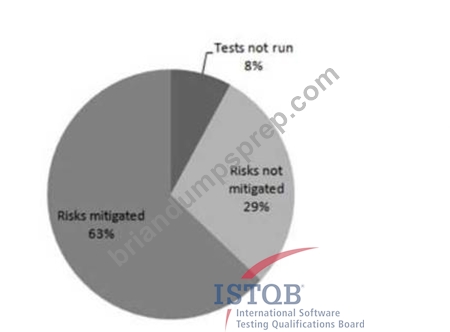
- A. Project is at risk due to the number of failed tests
- B. Project is on schedule based on total number of test cases executed
- C. Project is behind schedule based on bug fix rate
- D. Project is ahead of schedule due to number of risks addressed
Answer: A
Explanation:
The graph indicates that a significant portion of risks, 29%, have not been mitigated, which suggests that these are either failed tests or other discovered failures. This level of unmitigated risk puts the project at risk, as it implies that there are still substantial issues that need to be addressed.
Reference:
The ISTQB Advanced Level Test Manager documents outline the importance of risk-based testing and the interpretation of residual risk graphs. These graphs are used to communicate the current status of risk mitigation efforts in the project, and a high percentage of unmitigated risks is a clear indicator of potential problems1.
NEW QUESTION # 56
Consider the following scenario:
Your customer is closely involved in the development project. Requirements are communicated verbally and rarely written down. An iterative development model is being followed and time boxing is used to stay on schedule.
Which of the following statements is true? [3]
- A. Your developers are using a waterfall methodology.
- B. A requirements traceability matrix will be created at the start of each iteration.
- C. Testing will start when all coding is completed.
- D. There is a risk that the system architecture may have to be changed during the development process.
Answer: D
Explanation:
In an iterative development model with close customer involvement and verbal communication of requirements, there is an inherent risk of changes in the system architecture. This is due to the evolving understanding of requirements and the potential for new requirements to emerge as the project progresses.
Reference:
The ISTQB Advanced Level Test Manager syllabus emphasizes the importance of managing risks in iterative development models1. It suggests that test managers should be prepared for changes, including possible alterations to the system architecture, as part of the risk management process23. This approach ensures that the testing strategy remains flexible and responsive to changes throughout the development lifecycle.
NEW QUESTION # 57
Test results are reported as "Requirements tested, passed, and failed".
What test strategy are you using? [1]
- A. Exploratory
- B. Reactive
- C. Analytical
- D. Model-based
Answer: C
Explanation:
An analytical test strategy is a test strategy that is based on the analysis of the factors that affect the quality of the software under test, such as the requirements, the risks, the complexity, or the criticality1. An analytical test strategy uses these factors to define the test objectives, scope, approach, and techniques, as well as to prioritize and allocate the test resources2. Reporting the test results as "Requirements tested, passed, and failed" implies that the testing is driven by the requirements, which are the specifications of the desired features and functions of the software under test. Testing based on the requirements is an example of an analytical test strategy, as it uses the requirements as the main factor to guide the testing activities. Therefore, option C is the correct answer. Option A is incorrect because a model-based test strategy is a test strategy that uses models to represent the desired behavior and structure of the software under test, and to derive test cases, test data, test procedures, and test oracles. A model-based test strategy does not necessarily report the test results as "Requirements tested, passed, and failed", as it may use other types of models, such as state diagrams, data flow diagrams, or decision tables, to generate and execute the tests. Option B is incorrect because an exploratory test strategy is a test strategy that uses the tester's knowledge, skills, and creativity to design and execute tests dynamically, without predefined test cases or test procedures. An exploratory test strategy does not report the test results as "Requirements tested, passed, and failed", as it does not follow a formal or structured testing process, but rather relies on the tester's intuition, experience, and feedback. Option D is incorrect because a reactive test strategy is a test strategy that uses the actual behavior and results of the software under test to design and execute tests, without prior knowledge or documentation of the software. A reactive test strategy does not report the test results as "Requirements tested, passed, and failed", as it does not have any requirements or specifications to compare the software against, but rather uses the software itself as the test basis. Reference: 1: ISTQB Glossary, Analytical Test Strategy 2: ISTQB Advanced Level Test Manager Syllabus, Section 1.1.1 : ISTQB Glossary, Requirement : ISTQB Advanced Level Test Manager Syllabus, Section 1.1.1 : ISTQB Glossary, Model-Based Testing : ISTQB Advanced Level Test Manager Syllabus, Section 1.1.1 : ISTQB Glossary, Exploratory Testing : ISTQB Advanced Level Test Manager Syllabus, Section 1.1.1 : ISTQB Glossary, Reactive Test Strategy : ISTQB Advanced Level Test Manager Syllabus, Section 1.1.1 : Test Strategy | ISTQB Glossary : Test Strategy - ISTQB not-for-profit association
NEW QUESTION # 58
It is now the last day of the second iteration and the team has been consistently underestimating the time needed. They estimate intuitively rather than using estimation techniques.
Which two estimation techniques would be BEST for the team in this scenario?
- A. Wideband Delphi
- B. Planning poker
- C. 3-point estimation
- D. Velocity extrapolation
- E. Estimation of test effort based on ratio
Answer: B,C
Explanation:
* C (3-point estimation):Offers a structured approach to improve accuracy by accounting for uncertainty.
* D (Planning poker):Commonly used in Agile; supports collaborative and experiential-based estimation.
"Planning poker is an example of the expert-based approach... team members are estimating the effort to deliver a feature based on their experience."
- ISTQB-CTFL_Syllabus_2018_V3.1, section 5.2.6
NEW QUESTION # 59
You have just conducted a skills assessment for your team. You decided to rate everyone from 1 to 5 in the skill areas as follows:
5 = expert
4 = proficient
3 = can use this skill effectively but will need some assistance
2 = interested in learning this skill but has only minimal knowledge
1 = not interested in learning this skill
Given these values, you have rated your team as shown in the table below for the designated skill areas: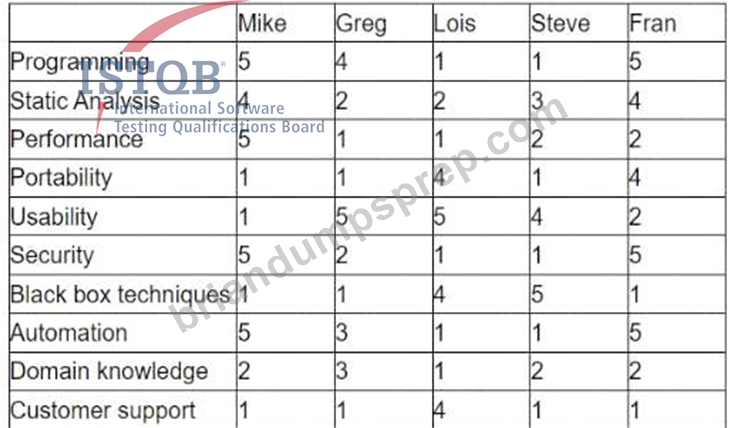
You will be starting to test a new product that is an upgrade from one of your existing end user products. Your testing will include white box, performance, security, usability, and black box. You also have a goal to automate 100% of the smoke test and
50% of the regression tests by the end of the release.
Your team willingly shares knowledge and conducts regular lunch time cross-training sessions.
Your manager wants to know if you would like to bring in someone to help train your team in preparation for this project. In which area could you best utilize this help? [3]
- A. Training in customer support
- B. Training in black box techniques
- C. Training in automation
- D. Training in domain knowledge
Answer: C
Explanation:
Based on the table, the area where your team could best utilize help is training in automation. This is because most of your team members are either not interested in learning this skill or have only minimal knowledge about it. Automation is an important skill for testing, especially for achieving your goal of automating the smoke test and the regression test. Training in automation can help your team to learn how to use various tools and frameworks to create, execute, and maintain automated test scripts. Training in automation can also improve the efficiency, effectiveness, and coverage of your testing process. Best Automation Courses & Certificates OnlineTraining - ISATop Automation Courses Online References:
* Best Automation Courses & Certificates Online
* Training - ISA
* Top Automation Courses Online
NEW QUESTION # 60
Which of the following is a factor that is likely to increase the test estimate? [1]
- A. Assigned personnel who are experienced on working with similar projects in similar environments
- B. A requirement for high level test documentation
- C. Use of a new technology
- D. Static test data
Answer: C
Explanation:
A test estimate is an approximation of the amount of effort, time, and resources required to perform testing activities for a software project1. A test estimate can be influenced by various factors, such as the size, complexity, and quality of the software, the scope, objectives, and approach of the testing, the skills, experience, and availability of the test team, the tools, methods, and standards used for testing, and the constraints, risks, and assumptions related to the project2. One of the factors that is likely to increase the test estimate is the use of a new technology. A new technology is a technology that is unfamiliar or unproven to the test team or the organization, such as a new programming language, framework, platform, or tool3. The use of a new technology can increase the test estimate because it may require more time and effort to learn, understand, and apply the technology, as well as to deal with potential issues, challenges, or limitations that may arise from the technology. Therefore, option A is the correct answer. Option B is incorrect because a requirement for high level test documentation is not a factor that is likely to increase the test estimate, but rather a factor that is likely to increase the test documentation effort. Test documentation is the set of documents that describe the test basis, test objectives, test design, test procedures, test results, and test evaluation of a software project. A requirement for high level test documentation means that the test documents need to be detailed, comprehensive, and consistent, which may require more time and effort to produce, review, and maintain. However, this does not necessarily affect the test estimate, as the test documentation effort can be considered as a separate or parallel activity to the test execution effort. Option C is incorrect because assigned personnel who are experienced on working with similar projects in similar environments is not a factor that is likely to increase the test estimate, but rather a factor that is likely to decrease the test estimate. Experienced personnel are personnel who have the relevant knowledge, skills, and abilities to perform the testing activities for a software project. Assigned personnel who are experienced on working with similar projects in similar environments can decrease the test estimate because they may require less time and effort to understand, design, implement, and execute the tests, as well as to deal with potential issues, challenges, or limitations that may arise from the project. Option D is incorrect because static test data is not a factor that is likely to increase the test estimate, but rather a factor that is likely to decrease the test estimate. Test data is the data that is used as input or output for the tests. Static test data is test data that is fixed and predefined, and does not change during the test execution. Static test data can decrease the test estimate because it may require less time and effort to create, manage, and maintain, as well as to ensure the validity, reliability, and traceability of the test data. Reference: 1: ISTQB Glossary, Test Estimate 2: ISTQB Advanced Level Test Manager Syllabus, Section 3.1.1 3: What is New Technology? - Definition from Techopedia : The Impact of New Technologies on Software Testing : ISTQB Glossary, Test Documentation : ISTQB Glossary, Experienced-Based Test Technique : ISTQB Glossary, Test Data : ISTQB Glossary, Static Test Data : Test Manager - ISTQB not-for-profit association : [ISTQB Foundation Level #38 - Test Estimation Techniques - Software Testing Mentor] : [What are the estimation techniques in software testing?]
NEW QUESTION # 61
When, at a minimum, should project risks be re-evaluated?
- A. At major project milestones
- B. Prior to test case creation
- C. At the beginning of the test execution phase
- D. During the creation of the test plan
Answer: A
NEW QUESTION # 62
You have directed one of your testers to construct a "smoke test" to execute against new builds prior to starting formal testing. This is an example of which software development lifecycle activity?
[1]
- A. Project management
- B. Technical support
- C. Change and configuration management
- D. Software development and maintenance
Answer: C
Explanation:
The correct answer is C. Change and configuration management. This is because a smoke test is a type of test that checks the basic functionality and stability of a new build before proceeding to more detailed testing. A smoke test is an example of change and configuration management, which is the activity of controlling and tracking the changes made to the software and its configuration items throughout the software development lifecycle. References: Certified Tester Advanced Level Test Manager (CTAL-TM) - ISTQB not-for-profit association, ISTQB Test Manager Certification - ISTQB Exams Worldwide - ISTQB Official Registration, Managing the Test Team - ISTQB not-for-profit association
NEW QUESTION # 63
You are considering involving users during test execution. In general, what is the main reason for involving users during test execution? 1 credit
- A. They are a cheap resource
- B. They have good testing skills
- C. They have the ability to also focus on invalid test cases
- D. This can serve as a way to build their confidence in the system
Answer: D
Explanation:
Explanation/Reference:
Explanation:
NEW QUESTION # 64
Your application development team is performing "test-driven" development. This is a core principal of which software development model?
- A. Iterative
- B. Agile
- C. Spiral
- D. Sequential
Answer: B
Explanation:
Test-driven development (TDD) is a core principle of Agile software development. In TDD, test cases are created before the code is written, and the code is developed to pass these tests. This approach emphasizes requirements and solutions evolving through collaborative effort and is a key practice in Agile methodologies12.
References:The Agile Alliance describes TDD as a style of programming tightly interwoven with coding, testing, and design, which is a fundamental aspect of Agile development3. Wikipedia also notes that TDD is related to the test-first programming concepts of extreme programming, an Agile methodology This is because test-driven development (TDD) is a style of programming in which coding, testing, and design are tightly interwoven. TDD is a core principle of agile software development, which is an iterative and adaptive approach that values customer collaboration, working software, and responding to change. Agile Alliance References: Certified Tester Advanced Level Test Manager (CTAL-TM) - ISTQB not-for-profit association, ISTQB Test Manager Certification - ISTQB Exams Worldwide - ISTQB Official Registration, What is Test Driven Development (TDD)? | Agile Alliance
NEW QUESTION # 65
You are monitoring the test results for the first week of system test execution to ensure they conform to the test plan objectives. You are guided by the list of test conditions and traceability matrix produced following test design. Test Plan objectives
* Approach - Risk-based and depth first
* Status reporting - Execution statuses must be either "Passed*, "Failed", "Blocked" or "Not Run"
* Traceability - Test execution results must be traceable back to the test conditions Test Conditions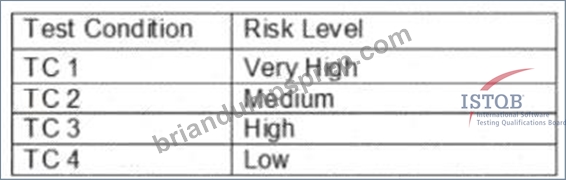
Traceability matrix
Which one of the following is a correct statement regarding the current status of test plan objectives?
SELECT ONE OPTION
- A. All the Traceability objective has been met.
- B. All objectives have been met.
- C. Only Approach and Traceability objectives have been met.
- D. None of the objectives have been met.
Answer: A
NEW QUESTION # 66
......
What is the duration, language, and format of CTAL-TM Exam
- Format: Multiple choices Questions
- Number of Questions: 65
- Passing score: 65%
- Length of Examination: 180 minutes
- Language: English
Valid CTAL-TM-001 Exam Updates - 2026 Study Guide: https://passleader.briandumpsprep.com/CTAL-TM-001-prep-exam-braindumps.html
